
EU Peer Review Finds No Immediate Risks to Maltese Crypto Licenses

Malta’s financial regulator has confirmed that none of the licenses issued under the Markets in Crypto-Assets Regulation (MiCA) are in danger of being revoked or re-evaluated following a recent peer review by the European Securities and Markets Authority (ESMA).

A spokesperson for the Malta Financial Services Authority (MFSA) stated that all identified issues have already been addressed or are in the process of resolution. This reinforces the island’s long-standing commitment to leading regulatory compliance within the European crypto framework.
Malta’s Early Entry Into Crypto Oversight

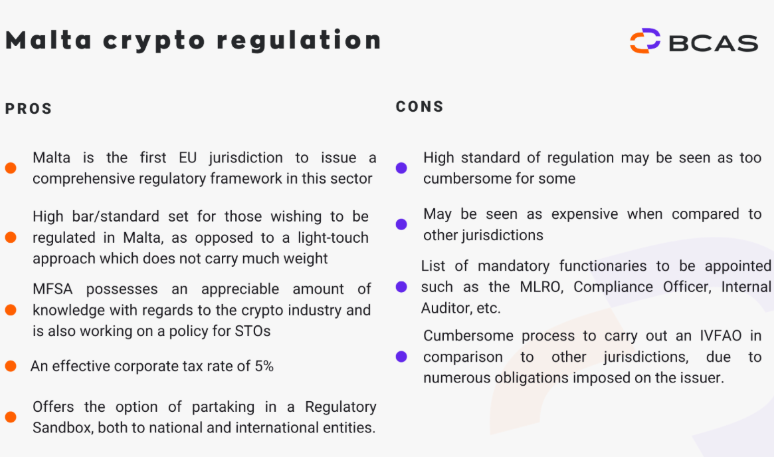
Malta has been at the forefront of crypto regulation since 2018, when it introduced a trio of legislative bills to govern digital assets and distributed ledger technology (DLT). At the time, it became the first EU country to regulate crypto assets holistically, including the technological and financial components of the sector.

This early leadership has positioned Malta as a key player in the MiCA rollout, which is shaping the future of regulated crypto services across the European Union.

Positive Acknowledgment from the EU

The ESMA review acknowledged Malta’s proactive stance, noting that its framework predates MiCA itself. According to the MFSA, this peer review serves as a “validation” of Malta’s efforts and may boost confidence among crypto firms seeking licensing within the EU.

MFSA CEO Kenneth Farrugia highlighted Malta’s continued cooperation with EU authorities, and emphasized that the recommendations made in the peer review would be fully implemented by September 2025.

Focus Areas for Improvement

Despite the positive tone, the ESMA review did outline areas for further enhancement. These include:

  • Assessing growth strategies of crypto asset service providers (CASPs)
  • Monitoring conflicts of interest within multi-service providers
  • Evaluating risks posed by decentralized finance (DeFi) platforms

The MFSA has committed to addressing these recommendations without delay.

Skepticism and Past Challenges

While Malta’s reputation as a “blockchain island” remains strong, the nation has not escaped scrutiny. Between 2018 and 2020, over 70% of initial applicants failed to secure licenses under its framework, suggesting high compliance thresholds. Furthermore, some firms registered in Malta were later revealed to be unlicensed operators, sparking questions about oversight during the early days of regulation.


Conclusion

Despite past challenges, Malta’s crypto licensing regime remains robust and EU-compliant. With MiCA now in full swing, Malta’s established framework and updated policies may serve as a model for responsible innovation across Europe.

Disclaimer

This content is for informational purposes only and does not constitute financial, investment, or legal advice. Cryptocurrency trading involves risk and may result in financial loss.

bitxjournal.com

info@bitxjournal.com

Bitxjournal Copyright © 2025, All rights reserved

News
Rates
Buy
More
We use cookies to personalize content and ads, provide social media features, and analyze our traffic. In accordance with GDPR/AVG and EU cookie regulations, data is processed only with your consent. We may share information about your use of our website with our social media, advertising, and analytics partners, and you can manage or withdraw your consent at any time. View more
Cookies settings
Accept
Privacy & Cookie policy
Privacy & Cookies policy
Cookie name Active

Privacy Policy

At BitxJournal.com, we respect your privacy and are committed to protecting your personal data. This Privacy Policy explains how we collect, process, store, and protect personal information in accordance with the General Data Protection Regulation (GDPR) and AVG (EU privacy legislation).

1. Data Controller

BitxJournal.com acts as the data controller for all personal data processed through this website.

2. Personal Data We Collect

We may collect and process the following categories of data:

Personal Data

  • Name and email address (when you subscribe to newsletters or contact us)

Technical & Usage Data

  • IP address, browser type, operating system

  • Device information

  • Pages visited, referral sources, and interaction data

This data is collected via cookies, log files, and analytics technologies.

3. Legal Basis for Processing

We process personal data only when a lawful basis exists, including:

  • Consent – when you explicitly agree (e.g., cookies, newsletter sign-up)

  • Legitimate interest – to operate, secure, and improve our website

  • Legal obligation – when required by applicable laws

You may withdraw your consent at any time.

4. Purpose of Data Processing

Your data is processed for the following purposes:

  • Operating and maintaining the website

  • Improving content, usability, and performance

  • Sending newsletters or updates (only with consent)

  • Analyzing traffic and user behavior

  • Responding to inquiries or support requests

5. Cookies & Consent Management

We use cookies and similar technologies in compliance with EU Cookie Law.

  • Non-essential cookies are placed only after explicit user consent

  • Users may accept, reject, or manage cookie preferences at any time

  • Consent can be withdrawn without affecting prior lawful processing

Detailed cookie information is available in our Cookie Settings panel.

6. Third-Party Data Processing

We may share limited data with trusted third-party service providers, including:

  • Analytics providers (e.g., Google Analytics)

  • Advertising partners (for personalized or non-personalized ads)

These third parties act as data processors and process data only under contractual obligations compliant with GDPR/AVG.

7. International Data Transfers

Where data is transferred outside the European Economic Area (EEA), we ensure appropriate safeguards are in place, such as Standard Contractual Clauses (SCCs) or equivalent legal mechanisms.

8. Data Retention

We retain personal data only for as long as necessary to fulfill the purposes outlined in this policy or as required by law.

9. Data Security

We implement appropriate technical and organizational security measures to protect personal data against unauthorized access, alteration, disclosure, or destruction.

10. Your GDPR Rights

Under GDPR/AVG, you have the right to:

  • Access your personal data

  • Rectify inaccurate or incomplete data

  • Request data erasure (“right to be forgotten”)

  • Restrict or object to processing

  • Data portability

  • Withdraw consent at any time

  • Lodge a complaint with a supervisory authority

11. Changes to This Privacy Policy

We reserve the right to update this Privacy Policy at any time. Any changes will be posted on this page with a revised effective date.

12. Contact Information

For privacy-related inquiries or GDPR requests, contact:

📧 Email: support@bitxjournal.com
🌐 Website: https://bitxjournal.com

Save settings
Cookies settings