FTX Bankruptcy Case Raises Alarms Over International Creditor Rights
The upcoming U.S. bankruptcy court ruling on the FTX estate’s motion to withhold payouts to creditors in “restricted jurisdictions” — including China, Saudi Arabia, and 47 other countries — has drawn global scrutiny. The decision, expected this week from the Delaware bankruptcy court, could affect billions in claims and reshape how offshore exchanges handle insolvencies.
More than 40 formal objections have already been filed, with some estimates suggesting the real number exceeds 69 objections, mostly from Chinese creditors.
What Are “Restricted Jurisdictions” and Why It Matters
The FTX estate motion proposes excluding creditors from 49 countries, citing regulatory and legal concerns. Critics argue that the list was not determined by any court but created through internal legal opinions, without judicial oversight.
This could open the door for future bankruptcies to unilaterally block payouts to certain nations, effectively seizing user funds without recourse.
“Restricted lists aren’t determined by judges. They just need to hire a lawyer to write a memo — and that’s it,” said one Chinese creditor.
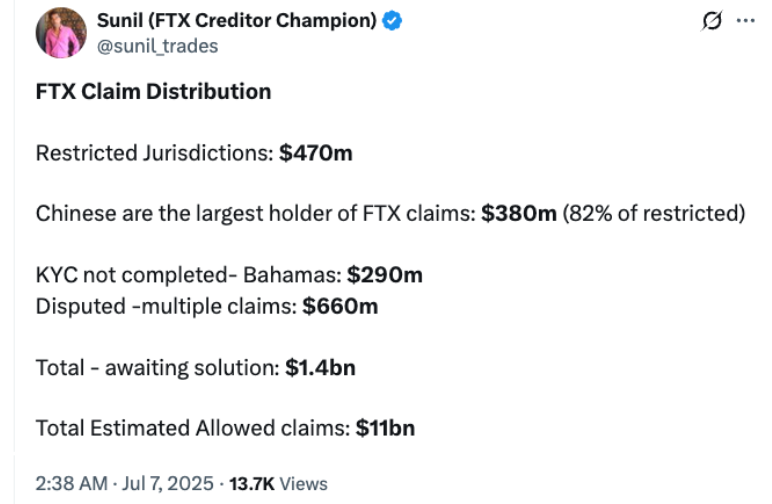
According to court data, Chinese users represent over 82% of the total value in claims from the affected jurisdictions. The motion’s approval could therefore disproportionately impact Chinese investors, with over $380 million in claims from China still unresolved.
One investor warned that approval could “destroy trust in the global crypto ecosystem,” especially for users in countries where crypto is not explicitly banned.
Broader International Pushback and Legal Arguments
Objections have also been filed from Saudi Arabia, where claimants argue their country does not ban crypto ownership, and that denying recovery would be unjust discrimination.
“My country does not prohibit cryptocurrency ownership or trading. Regulatory fears are speculative and not a valid legal basis for denying recovery,” stated a Saudi creditor.
Other objections come from unspecified locations, including from individuals in Eastern Europe and Africa, raising concerns about fair treatment in global bankruptcy proceedings.
FTX Claim Prices Plunge for Restricted Jurisdictions
The uncertainty has already had a direct financial impact. Credit platforms like Paxtibi report a 20–30% drop in the value of FTX claims tied to restricted jurisdictions. Over $5.8 billion in FTX claims have been traded, often at steep discounts due to legal ambiguity.
One creditor noted, “The price offered is, in my view, not very friendly. I’m still fighting to get what we rightfully deserve — not to be forced into selling our claims.”
Conclusion: A Legal Crossroads for Crypto Insolvency Cases
This ruling could mark a turning point for digital asset litigation. If approved, the FTX motion may become a template for future crypto bankruptcy cases, allowing companies to sidestep creditor protections based on geography.
As the world awaits the court’s decision, the broader issue remains: Should a private crypto estate be allowed to redraw the map of who deserves justice in insolvency?
Disclaimer
This content is for informational purposes only and does not constitute financial, investment, or legal advice. Cryptocurrency trading involves risk and may result in financial loss.
We use cookies to personalize content and ads, provide social media features, and analyze our traffic. In accordance with GDPR/AVG and EU cookie regulations, data is processed only with your consent. We may share information about your use of our website with our social media, advertising, and analytics partners, and you can manage or withdraw your consent at any time. View more
Cookies settings
Accept
Privacy & Cookie policy
Privacy & Cookies policy
Cookies list
Cookie name
Active
Privacy Policy
At BitxJournal.com, we respect your privacy and are committed to protecting your personal data. This Privacy Policy explains how we collect, process, store, and protect personal information in accordance with the General Data Protection Regulation (GDPR) and AVG (EU privacy legislation).
1. Data Controller
BitxJournal.com acts as the data controller for all personal data processed through this website.
2. Personal Data We Collect
We may collect and process the following categories of data:
Personal Data
Name and email address (when you subscribe to newsletters or contact us)
Technical & Usage Data
IP address, browser type, operating system
Device information
Pages visited, referral sources, and interaction data
This data is collected via cookies, log files, and analytics technologies.
3. Legal Basis for Processing
We process personal data only when a lawful basis exists, including:
Consent – when you explicitly agree (e.g., cookies, newsletter sign-up)
Legitimate interest – to operate, secure, and improve our website
Legal obligation – when required by applicable laws
You may withdraw your consent at any time.
4. Purpose of Data Processing
Your data is processed for the following purposes:
Operating and maintaining the website
Improving content, usability, and performance
Sending newsletters or updates (only with consent)
Analyzing traffic and user behavior
Responding to inquiries or support requests
5. Cookies & Consent Management
We use cookies and similar technologies in compliance with EU Cookie Law.
Non-essential cookies are placed only after explicit user consent
Users may accept, reject, or manage cookie preferences at any time
Consent can be withdrawn without affecting prior lawful processing
Detailed cookie information is available in our Cookie Settings panel.
6. Third-Party Data Processing
We may share limited data with trusted third-party service providers, including:
Analytics providers (e.g., Google Analytics)
Advertising partners (for personalized or non-personalized ads)
These third parties act as data processors and process data only under contractual obligations compliant with GDPR/AVG.
7. International Data Transfers
Where data is transferred outside the European Economic Area (EEA), we ensure appropriate safeguards are in place, such as Standard Contractual Clauses (SCCs) or equivalent legal mechanisms.
8. Data Retention
We retain personal data only for as long as necessary to fulfill the purposes outlined in this policy or as required by law.
9. Data Security
We implement appropriate technical and organizational security measures to protect personal data against unauthorized access, alteration, disclosure, or destruction.
10. Your GDPR Rights
Under GDPR/AVG, you have the right to:
Access your personal data
Rectify inaccurate or incomplete data
Request data erasure (“right to be forgotten”)
Restrict or object to processing
Data portability
Withdraw consent at any time
Lodge a complaint with a supervisory authority
11. Changes to This Privacy Policy
We reserve the right to update this Privacy Policy at any time. Any changes will be posted on this page with a revised effective date.
12. Contact Information
For privacy-related inquiries or GDPR requests, contact: