
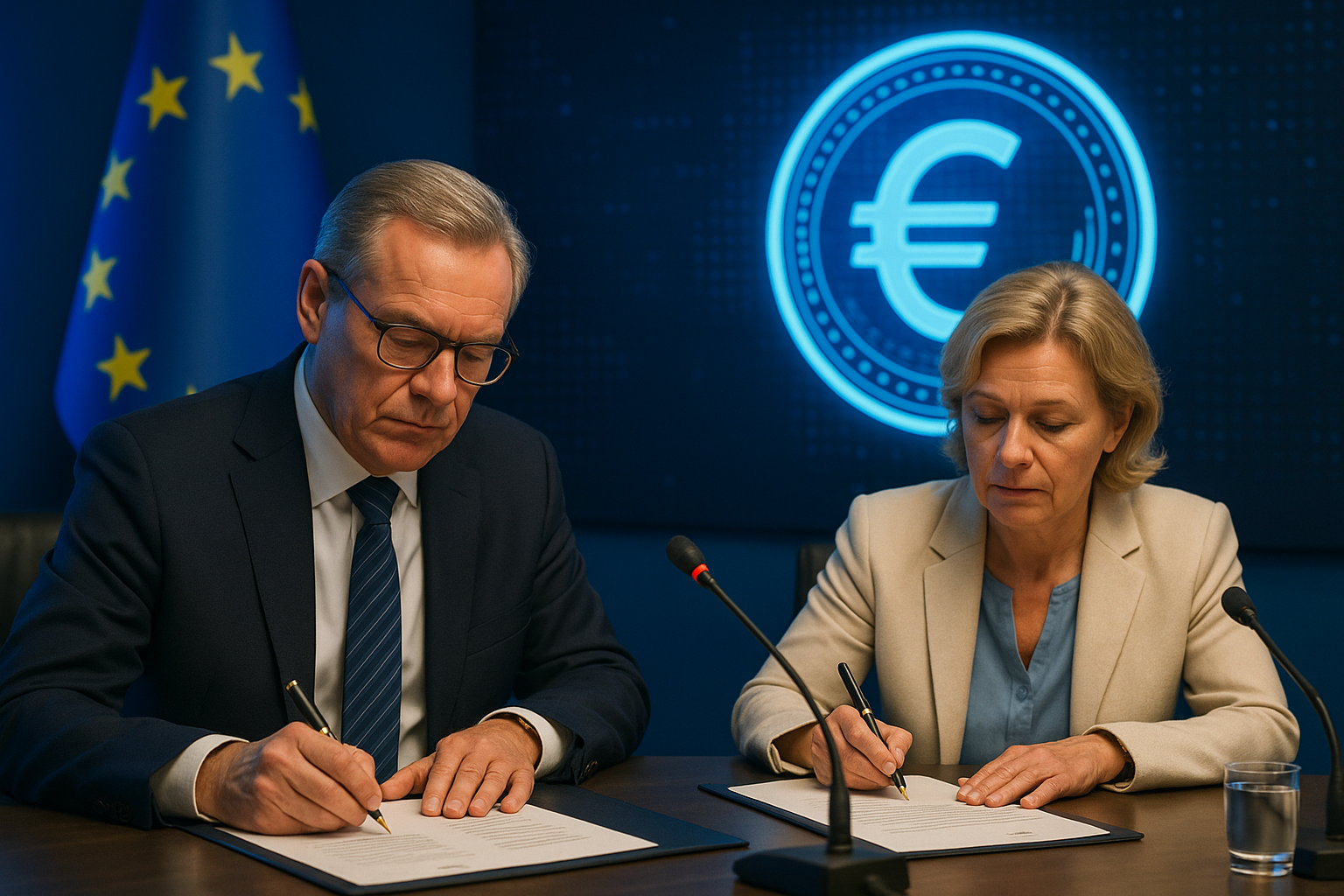
Consensus reached on procedures to cap individual CBDC balances
European Union finance ministers have agreed on a pathway to impose holding limits for the digital euro, a move that marks a significant step toward launching the bloc’s long-discussed central bank digital currency (CBDC). The agreement was reached during the Eurogroup meeting held alongside the Economic and Financial Affairs Council in Copenhagen, Denmark.
A Framework for Caps
Officials emphasized that while the exact holding limits have not yet been determined, consensus was achieved on the procedures for establishing caps and on the eventual issuance process for the digital euro. The framework aims to balance innovation with financial stability, amid concerns that unrestricted CBDC adoption could draw deposits away from commercial banks.
The European Central Bank (ECB) first floated the idea of holding limits in its 2024 digital euro progress report, sparking debate among national central banks and policymakers. Limits are seen as essential to preventing risks to the banking sector while ensuring that the digital euro functions as a means of payment rather than a store of value.
Privacy and Accessibility at the Core
ECB board member Piero Cipollone recently stressed that the digital euro would be designed with privacy protections and offline capabilities:
“The system will ensure that all Europeans can pay at all times with a free, universally accepted digital means of payment, even in case of major disruptions.”
He added that offline payments would be “as good as cash” in terms of preserving privacy.
Competing With Stablecoins
The EU’s decision comes as stablecoins continue to rise globally, challenging traditional monetary systems. Policymakers see the digital euro as a strategic response to the growing dominance of dollar-based stablecoins.
Former ECB official and current Bank of Italy Governor Fabio Panetta has argued that regulation alone cannot address crypto risks.
“We would be remiss to think that the evolution of crypto-assets can be controlled only through rules and restrictions,” he said, highlighting the digital euro as a key instrument to safeguard Europe’s financial sovereignty.
With holding limits now on the horizon, the EU edges closer to its goal of creating a secure, accessible, and widely accepted digital alternative to cash.
Disclaimer
This content is for informational purposes only and does not constitute financial, investment, or legal advice. Cryptocurrency trading involves risk and may result in financial loss.