Changpeng Zhao Denies Involvement in Trump-Linked Stablecoin
Changpeng Zhao (CZ), the co-founder and former CEO of Binance, has publicly rejected claims that he played a role in developing or backing USD1, a stablecoin linked to World Liberty Financial (WLF) — a firm tied to U.S. President Donald Trump.
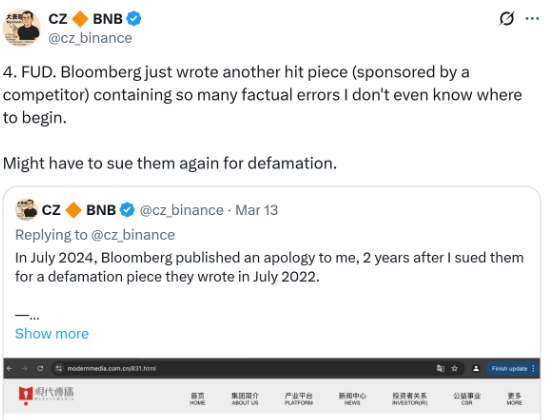
In a post on the social platform X, Zhao labeled the report as a “hit piece” and stated that it was “sponsored by a competitor.” He warned that he “might have to sue again for defamation,” highlighting that the article was “filled with so many factual errors.”
Report Claims USD1 Was Developed by Binance
The now-controversial article alleged that Binance originally developed the smart contract code behind USD1. It further claimed that over 90% of USD1 tokens remain in Binance wallets, potentially earning millions in interest income annually.
Additionally, the report suggested that Zhao applied for a presidential pardon shortly after USD1 was used in a $2 billion UAE-based fund investment deal involving Binance — a claim Zhao strongly denies.
“This is complete misinformation. Binance has no connection with USD1,” Zhao emphasized, challenging the narrative linking Binance to Trump’s financial ecosystem.
CZ’s History of Legal Battles With Media
This is not the first time Zhao has confronted the media over alleged inaccuracies. In 2024, he secured an apology from the Chinese-language edition of a major financial outlet, which had previously accused Binance of operating a Ponzi scheme. That publication later issued a formal retraction, describing the article as “false and baseless.”
Zhao also disputed a report published in April 2025 that claimed he was cooperating with U.S. authorities to testify against other crypto executives, calling it a coordinated smear campaign.
Background: Trump’s Expanding Crypto Presence
The issue comes amid growing scrutiny of Donald Trump’s expanding crypto involvement, including World Liberty Financial, his official memecoin, and multiple campaign donations from crypto industry executives.
In parallel, U.S. lawmakers are considering key legislation, such as the GENIUS Act, aimed at regulating stablecoins. The bill passed the Senate in 2025 with bipartisan support and is central to shaping the future of digital currency compliance in the U.S.
Conclusion
As political tensions rise and regulatory frameworks tighten, the relationship between crypto leadership and government policy is under the spotlight. Zhao’s threat to take legal action underscores the growing sensitivity around misinformation in the crypto space and highlights the broader implications of stablecoin regulation and political affiliations.
Disclaimer
This content is for informational purposes only and does not constitute financial, investment, or legal advice. Cryptocurrency trading involves risk and may result in financial loss.
We use cookies to personalize content and ads, provide social media features, and analyze our traffic. In accordance with GDPR/AVG and EU cookie regulations, data is processed only with your consent. We may share information about your use of our website with our social media, advertising, and analytics partners, and you can manage or withdraw your consent at any time. View more
Cookies settings
Accept
Privacy & Cookie policy
Privacy & Cookies policy
Cookies list
Cookie name
Active
Privacy Policy
At BitxJournal.com, we respect your privacy and are committed to protecting your personal data. This Privacy Policy explains how we collect, process, store, and protect personal information in accordance with the General Data Protection Regulation (GDPR) and AVG (EU privacy legislation).
1. Data Controller
BitxJournal.com acts as the data controller for all personal data processed through this website.
2. Personal Data We Collect
We may collect and process the following categories of data:
Personal Data
Name and email address (when you subscribe to newsletters or contact us)
Technical & Usage Data
IP address, browser type, operating system
Device information
Pages visited, referral sources, and interaction data
This data is collected via cookies, log files, and analytics technologies.
3. Legal Basis for Processing
We process personal data only when a lawful basis exists, including:
Consent – when you explicitly agree (e.g., cookies, newsletter sign-up)
Legitimate interest – to operate, secure, and improve our website
Legal obligation – when required by applicable laws
You may withdraw your consent at any time.
4. Purpose of Data Processing
Your data is processed for the following purposes:
Operating and maintaining the website
Improving content, usability, and performance
Sending newsletters or updates (only with consent)
Analyzing traffic and user behavior
Responding to inquiries or support requests
5. Cookies & Consent Management
We use cookies and similar technologies in compliance with EU Cookie Law.
Non-essential cookies are placed only after explicit user consent
Users may accept, reject, or manage cookie preferences at any time
Consent can be withdrawn without affecting prior lawful processing
Detailed cookie information is available in our Cookie Settings panel.
6. Third-Party Data Processing
We may share limited data with trusted third-party service providers, including:
Analytics providers (e.g., Google Analytics)
Advertising partners (for personalized or non-personalized ads)
These third parties act as data processors and process data only under contractual obligations compliant with GDPR/AVG.
7. International Data Transfers
Where data is transferred outside the European Economic Area (EEA), we ensure appropriate safeguards are in place, such as Standard Contractual Clauses (SCCs) or equivalent legal mechanisms.
8. Data Retention
We retain personal data only for as long as necessary to fulfill the purposes outlined in this policy or as required by law.
9. Data Security
We implement appropriate technical and organizational security measures to protect personal data against unauthorized access, alteration, disclosure, or destruction.
10. Your GDPR Rights
Under GDPR/AVG, you have the right to:
Access your personal data
Rectify inaccurate or incomplete data
Request data erasure (“right to be forgotten”)
Restrict or object to processing
Data portability
Withdraw consent at any time
Lodge a complaint with a supervisory authority
11. Changes to This Privacy Policy
We reserve the right to update this Privacy Policy at any time. Any changes will be posted on this page with a revised effective date.
12. Contact Information
For privacy-related inquiries or GDPR requests, contact: