

Crypto Facing Renewed Volatility Despite Strong Institutional and Regulatory Tailwinds
Bitcoin endured a sharp weekend downturn that briefly erased all gains accumulated since the start of 2025, underscoring the fragile sentiment weighing on global crypto markets. The slump came despite expectations of a relief rally after the U.S. government reopened on Thursday, ending a record 43-day shutdown.
The drop has reignited debate over market cycles, whale behavior, and whether broader macro pressures are overshadowing positive industry developments.
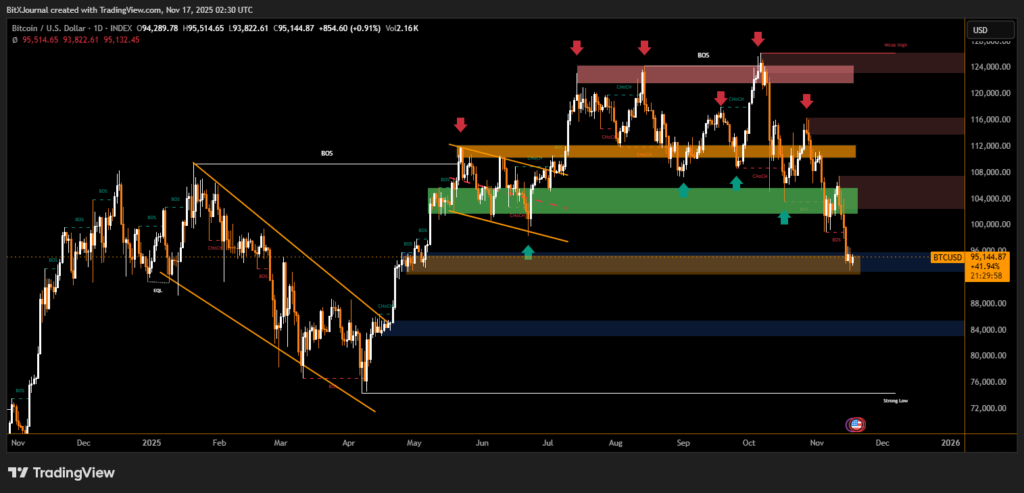
Bitcoin Slips Below Its 2025 Starting Price
Over the weekend, Bitcoin fell to $93,029, dipping below the $93,507 level at which it began the year.
The decline marks a 25% pullback from its October all-time high.
Prices have since recovered slightly, hovering near $94,209, according to market data.
2025 was expected to be a defining year for industry expansion, particularly after the inauguration of a U.S. administration considered the most pro-crypto in modern history.
The government has advanced regulatory clarity, supported corporate Bitcoin treasury allocation, and overseen growing inflows into spot Bitcoin ETFs.
But the optimism has been countered by macro turbulence. President Trump’s tariff battles and the extended government shutdown triggered multiple market-wide corrections.
These events have added pressure during moments when Bitcoin appeared poised to resume its rally.
Whale Selling Adds to Downward Pressure
Market watchers also point to large holders — often referred to as OG Bitcoiners — who have been trimming positions during the latest cycle.
While some believed whales were aggressively exiting, analysts at Glassnode said the behavior is typical late-cycle distribution, not a panic-driven sell-off.
“It’s normal bull-market behaviour, reflecting older cohorts taking profits as the cycle matures,” researchers noted.
Altcoins Hit Even Harder
Bitcoin’s decline coincided with broader weakness across the market.
Ether is down 7.95% year-to-date, while Solana has dropped 28.3%.
Most altcoins have suffered double-digit losses, deepening the sense of risk aversion.
Is the Four-Year Cycle Thesis Still Valid?
The downturn has revived discussion around whether Bitcoin’s traditional four-year cycle pattern remains intact.
Though institutional involvement has never been higher, some believe cycle dynamics could be shifting.
However, several industry analysts argue the fundamentals remain strong.
Bitwise CIO Matt Hougan reiterated last week that Bitcoin could see a major breakout in 2026, driven by macroeconomic pressures and escalating adoption in stablecoins, tokenization, and DeFi.
“The underlying fundamentals are just too strong,” Hougan said.
He added that the structural themes pushing digital assets forward are “too big to keep down.”
Disclaimer
This content is for informational purposes only and does not constitute financial, investment, or legal advice. Cryptocurrency trading involves risk and may result in financial loss.