
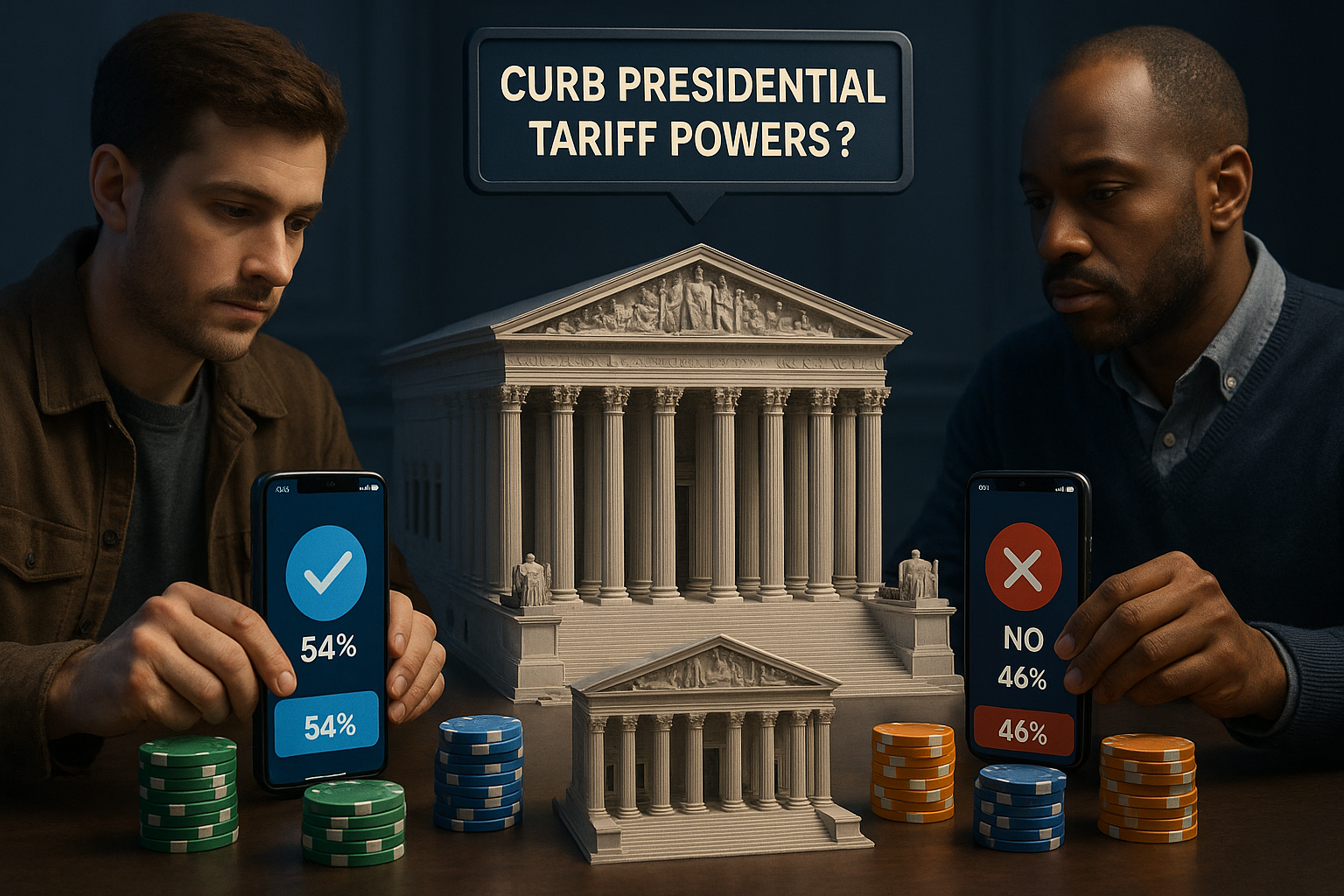
Prediction markets show steep declines in confidence that the Court will uphold Trump’s sweeping trade authority under emergency powers law.
Prediction Markets Turn Against Trump
Traders on Kalshi and Polymarket — two of the world’s most-watched prediction platforms — are signaling waning confidence that the U.S. Supreme Court will side with President Donald Trump in his bid to preserve broad tariff powers under a 1977 emergency statute.
As of Thursday, Kalshi traders assigned just a 29% probability that the Court will back Trump — a 28-point drop in one day. On Polymarket, which settles trades in USDC ($1), the odds fell to 25%, mirroring the same collapse in sentiment.

Combined, both markets saw over $1.3 million in trading volume, underlining how prediction markets can offer early, data-driven indicators of shifts in legal and political sentiment.
Traders Expect Limits on Presidential Tariff Authority
The sharp repricing followed this week’s Supreme Court hearings, where justices appeared skeptical of Trump’s claim that the International Emergency Economic Powers Act (IEEPA) allows the president to unilaterally impose tariffs without congressional approval.
If the Court ultimately limits executive trade authority, it could reshape presidential control over fiscal and tariff policy, marking one of the most consequential rulings of the current term.
The convergence between Kalshi and Polymarket odds also highlights how traditional (fiat-based) and decentralized (onchain) prediction markets are increasingly aligned — offering a cross-market consensus on likely judicial outcomes.

Justices Signal Skepticism Toward Expansive Executive Power
During Wednesday’s oral arguments, several conservative justices appointed by Trump — including Chief Justice John Roberts, Neil Gorsuch, and Amy Coney Barrett — pressed the administration on why such sweeping tariff powers should exist under an emergency framework.
Roberts emphasized that tariffs are a congressional function, noting that “taxes have always been the core power of Congress.”
Gorsuch cautioned that granting such discretion to the White House could create a “one-way ratchet” toward unchecked executive authority.
Barrett questioned why countries such as Spain and France were included in Trump’s prior tariff actions.
These exchanges contributed to the steep decline in prediction market confidence, as traders recalibrated their expectations toward a curb on presidential power.
Crypto Markets Watch Closely
Historically, Trump’s tariff policies have had a dual effect on crypto markets:
- Inflation fears during prior tariff rounds drove investors toward Bitcoin ($102,977) as a hedge against fiscal instability.
- However, market uncertainty often triggered short-term risk-off sentiment, leading to temporary crypto sell-offs.
If the Supreme Court curtails Trump’s authority, analysts say it could ease trade-driven volatility — potentially supporting broader market stability, including in the digital asset sector.
Prediction markets are increasingly pricing in a Supreme Court rebuke of Trump’s expansive tariff powers — a decision that could redefine the balance between Congress and the presidency on economic policy, while also influencing crypto’s macro landscape in the months ahead.
Disclaimer
This content is for informational purposes only and does not constitute financial, investment, or legal advice. Cryptocurrency trading involves risk and may result in financial loss.