

British neobank Revolut has made crypto-fiat conversion frictionless by introducing 1:1 USD-to-stablecoin swaps, removing all spreads, fees, and conversion costs for users.
Revolut Simplifies Stablecoin Conversion With Zero Fees
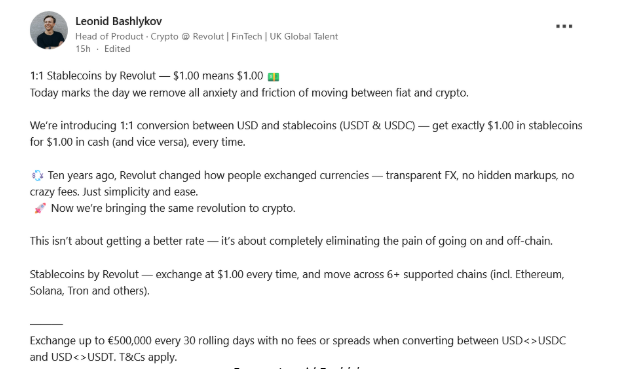
In a major push toward mainstream crypto adoption, Revolut unveiled its 1:1 Stablecoins feature, enabling users to convert USD to USDC or USDT at a perfect parity rate.
“Today marks the day we remove all anxiety and friction of moving between fiat and crypto,” said Leonid Bashlykov, Revolut’s head of crypto product, in a LinkedIn announcement. “$1.00 means $1.00.”
The update applies across six blockchains, including Ethereum, Solana, and Tron, and lets users exchange up to $578,630 every 30 days without incurring fees or slippage. Revolut will absorb the spread internally, provided the stablecoins remain pegged to the dollar.
Revolut, which held nearly $35 billion in customer assets in 2024, reported a 66% increase from the prior year as user engagement and monthly transactions surged.
New EU License Strengthens Revolut’s Crypto Expansion
The rollout follows Revolut’s recent approval under the Markets in Crypto-Assets (MiCA) framework, granting it a license from the Cyprus Securities and Exchange Commission. This allows the fintech to offer regulated crypto services in 30 European Economic Area countries.
Bashlykov emphasized that the initiative is not about getting better exchange rates, but about “completely eliminating the pain of going on and offchain.”
Industry observers say the move will have global implications, especially for emerging markets.
Experts Say 1:1 Swaps Could Transform SME Finance
According to Elbruz Yılmaz, managing partner at venture capital firm Outrun, the new system could revolutionize how small businesses handle cross-border transactions.
“A clean one-to-one ramp turns stablecoins from a speculative asset into working capital infrastructure,” Yılmaz explained. “Faster cycles. Less FX bleed. Better treasury control.”
This could be particularly impactful in countries with volatile currencies, such as Turkey, where firms lose significant value through currency conversion and international transfer fees.
Fintechs Race Toward Stablecoin Integration
Revolut’s move follows a broader trend of financial technology companies integrating blockchain-based settlements.
Western Union recently revealed plans to launch a Solana-based stablecoin settlement system in early 2026, featuring its USD Payment Token (USDPT). Similarly, Zelle and MoneyGram are exploring stablecoin-powered cross-border payment solutions, while SWIFT is developing a blockchain network for tokenized asset transfers.
By offering a truly frictionless on-ramp between fiat and crypto, Revolut has positioned itself at the forefront of a new era in digital finance — one where stablecoins function not as speculation, but as seamless payment infrastructure.
Disclaimer
This content is for informational purposes only and does not constitute financial, investment, or legal advice. Cryptocurrency trading involves risk and may result in financial loss.