
Robinhood Launches 24/7 Tokenized Stock Trading via Ethereum-Compatible Chain
Robinhood’s latest push into tokenized assets could pose a significant threat to traditional exchanges like the New York Stock Exchange (NYSE). The firm recently unveiled plans to launch “Robinhood Chain,” an Ethereum-compatible Layer-2 blockchain on Arbitrum Orbit, which will support 24/7 trading of tokenized stock derivatives.
At the EthCC conference, Robinhood CEO Vlad Tenev shared that the new chain will mint tokenized “wrappers” for real-world stocks, enabling near-instant settlement and self-custody options. Initially launching with 24/5 trading, the platform plans to move to full 24/7 stock trading — a model that directly contrasts with the NYSE’s limited market hours.
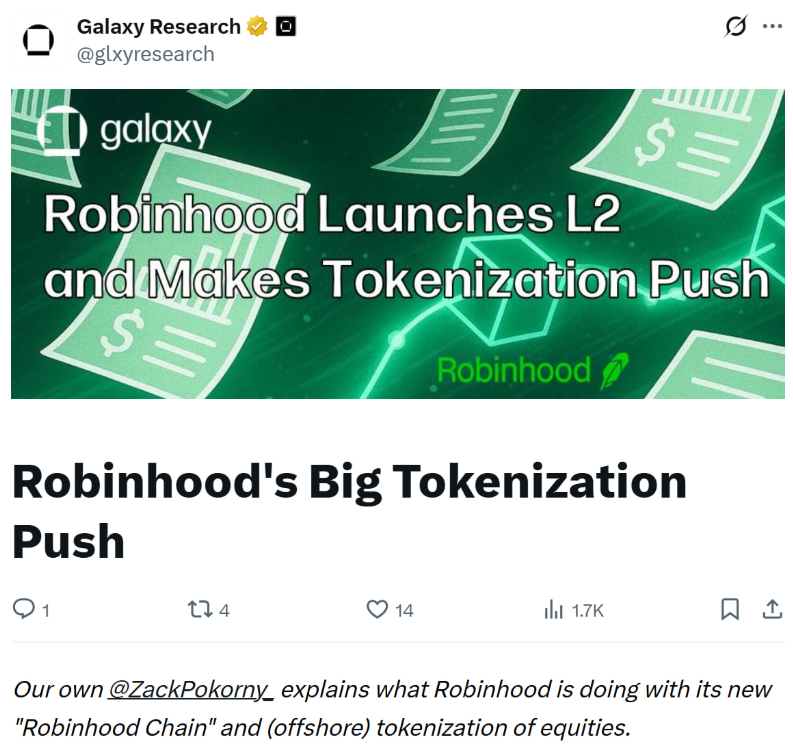
Galaxy Digital Warns of Liquidity Shift from Traditional Markets
In a recent analysis, **Galaxy Digital highlighted the risk that tokenized equities may divert liquidity from centralized exchanges like the NYSE. Traditional exchanges heavily rely on trading fees and market data sales, both of which could be impacted if significant volume shifts to onchain alternatives.
“This directly challenges the deep concentration of liquidity and activity that gives major TradFi exchanges their competitive advantage,” Galaxy’s report noted.
Robinhood Controls the Full Stack: From Asset Issuance to Fees
The Robinhood Chain architecture mirrors rollup models such as Coinbase’s Base, providing full control of its sequencer and associated transaction fees. According to Galaxy, Base earns over $150,000 in daily sequencer fees, suggesting Robinhood could unlock a new revenue stream.
By operating its own blockchain, Robinhood gains control over offchain trading, onchain transactions, and user interactions, allowing it to capture value at every stage.
Beyond Trading: Programmability Unlocks New Financial Tools
Tokenization isn’t just about 24/7 access. Programmable features of tokenized stocks can enable:
- Use of stocks as collateral in DeFi lending
- Automated dividend distribution
- Cross-platform interoperability
These are functionalities that traditional equities cannot offer, giving blockchain-based platforms a unique edge.
Regulatory and Volatility Challenges Still Loom
Despite the innovation, risks remain. 24/7 trading could expose retail investors to higher volatility, particularly outside of U.S. market hours. Additionally, regulatory clarity is still lacking in the U.S., as Robinhood’s tokens are currently restricted to EU users.
The Securities Industry and Financial Markets Association (SIFMA) has urged U.S. regulators to reject tokenized stock trading outside traditional regulatory frameworks, citing investor protection concerns.
Outlook
Robinhood’s move into tokenized equity trading signals a potential paradigm shift for global financial markets. If successful, it may push centralized exchanges to adapt or risk becoming outdated custodians of increasingly underutilized assets.
Disclaimer
This content is for informational purposes only and does not constitute financial, investment, or legal advice. Cryptocurrency trading involves risk and may result in financial loss.