

SEC Commissioner Hester Peirce has made a strong case for protecting financial privacy and the rights of crypto developers, stating that building privacy-focused tools shouldn’t be criminalized. Her comments come as the Tornado Cash trial moves toward a pivotal verdict.

Speaking at the Science of Blockchain Conference, Peirce warned that punishing open-source developers for how their code is used by others undermines basic freedoms.

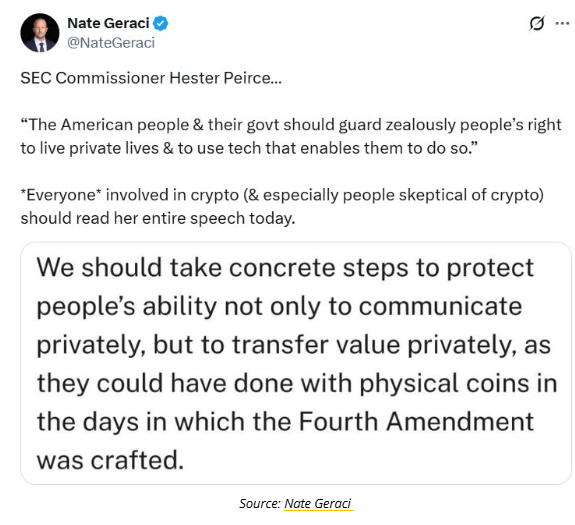
“People should be able not only to communicate privately but also to transfer value privately,” she said, likening this right to the era when physical cash ensured privacy.

Tornado Cash on Trial, Developers Under Fire

The case against Roman Storm, co-founder of Tornado Cash, has become a flashpoint in the debate over crypto privacy. The mixing protocol, designed to obscure the source and destination of transactions, is under scrutiny for allegedly being used by criminals to launder funds.
Storm faces up to 40 years in prison if convicted. His defense — and much of the Web3 community — argues that Tornado Cash is merely a tool and that its creators cannot control how people use it.

The trial has parallels to other ongoing investigations, including the recent guilty plea from Samourai Wallet’s co-founders, also charged for operating a crypto mixing service.

Peirce: Encryption Powers Progress, Not Crime

Drawing parallels to the 1990s crypto wars, Peirce referenced how developers like Phil Zimmermann, who created Pretty Good Privacy (PGP), fought to keep strong encryption accessible. That fight, she said, enabled today’s internet economy.

“The internet could not have succeeded without strong cryptography,” she emphasized, cautioning that stifling privacy innovation today may have long-term negative effects.

Opposing the DeFi Broker Rule

Peirce also voiced opposition to the now-defunct DeFi broker rule, which would have required decentralized platforms to report user transaction data to the IRS. The proposal, scrapped in April, was seen as a backdoor to mass financial surveillance.

“Requiring intermediaries in peer-to-peer crypto transfers would make us agents of surveillance — a dangerous precedent for a free society,” Peirce said.

What’s Next?

As the Tornado Cash verdict looms, the crypto community watches closely. The outcome could set a legal precedent for how developers of decentralized protocols are treated in the U.S.

Peirce’s speech underscores the growing tension between regulatory enforcement and technological liberty — a battle that could define the next decade of Web3.

Disclaimer

This content is for informational purposes only and does not constitute financial, investment, or legal advice. Cryptocurrency trading involves risk and may result in financial loss.

bitxjournal.com

info@bitxjournal.com

Bitxjournal Copyright © 2025, All rights reserved

News
Rates
Buy
More
We use cookies to personalize content and ads, provide social media features, and analyze our traffic. In accordance with GDPR/AVG and EU cookie regulations, data is processed only with your consent. We may share information about your use of our website with our social media, advertising, and analytics partners, and you can manage or withdraw your consent at any time. View more
Cookies settings
Accept
Privacy & Cookie policy
Privacy & Cookies policy
Cookie name Active

Privacy Policy

At BitxJournal.com, we respect your privacy and are committed to protecting your personal data. This Privacy Policy explains how we collect, process, store, and protect personal information in accordance with the General Data Protection Regulation (GDPR) and AVG (EU privacy legislation).

1. Data Controller

BitxJournal.com acts as the data controller for all personal data processed through this website.

2. Personal Data We Collect

We may collect and process the following categories of data:

Personal Data

  • Name and email address (when you subscribe to newsletters or contact us)

Technical & Usage Data

  • IP address, browser type, operating system

  • Device information

  • Pages visited, referral sources, and interaction data

This data is collected via cookies, log files, and analytics technologies.

3. Legal Basis for Processing

We process personal data only when a lawful basis exists, including:

  • Consent – when you explicitly agree (e.g., cookies, newsletter sign-up)

  • Legitimate interest – to operate, secure, and improve our website

  • Legal obligation – when required by applicable laws

You may withdraw your consent at any time.

4. Purpose of Data Processing

Your data is processed for the following purposes:

  • Operating and maintaining the website

  • Improving content, usability, and performance

  • Sending newsletters or updates (only with consent)

  • Analyzing traffic and user behavior

  • Responding to inquiries or support requests

5. Cookies & Consent Management

We use cookies and similar technologies in compliance with EU Cookie Law.

  • Non-essential cookies are placed only after explicit user consent

  • Users may accept, reject, or manage cookie preferences at any time

  • Consent can be withdrawn without affecting prior lawful processing

Detailed cookie information is available in our Cookie Settings panel.

6. Third-Party Data Processing

We may share limited data with trusted third-party service providers, including:

  • Analytics providers (e.g., Google Analytics)

  • Advertising partners (for personalized or non-personalized ads)

These third parties act as data processors and process data only under contractual obligations compliant with GDPR/AVG.

7. International Data Transfers

Where data is transferred outside the European Economic Area (EEA), we ensure appropriate safeguards are in place, such as Standard Contractual Clauses (SCCs) or equivalent legal mechanisms.

8. Data Retention

We retain personal data only for as long as necessary to fulfill the purposes outlined in this policy or as required by law.

9. Data Security

We implement appropriate technical and organizational security measures to protect personal data against unauthorized access, alteration, disclosure, or destruction.

10. Your GDPR Rights

Under GDPR/AVG, you have the right to:

  • Access your personal data

  • Rectify inaccurate or incomplete data

  • Request data erasure (“right to be forgotten”)

  • Restrict or object to processing

  • Data portability

  • Withdraw consent at any time

  • Lodge a complaint with a supervisory authority

11. Changes to This Privacy Policy

We reserve the right to update this Privacy Policy at any time. Any changes will be posted on this page with a revised effective date.

12. Contact Information

For privacy-related inquiries or GDPR requests, contact:

📧 Email: support@bitxjournal.com
🌐 Website: https://bitxjournal.com

Save settings
Cookies settings