

Rise of yield-bearing tokens and bank-issued stablecoins signals new competition for Tether and Circle
The dominance of Tether’s USDT and Circle’s USDC in the stablecoin market is slipping, with their combined share dropping to just 83.6%, according to fresh data from DefiLlama and CoinGecko. Analysts suggest that the long-standing “stablecoin duopoly” may be coming to an end as new players enter the market.
Market share decline
At their peak in March 2024, USDT and USDC together controlled 91.6% of the $140 billion stablecoin market. Since then, despite steady growth in their market caps, their dominance has slid more than 5%.
Industry analyst Nic Carter described the shift as significant. “The reasons are new assertiveness by intermediaries, a race to the bottom with yield, and new regulatory dynamics post-GENIUS,” he said, noting that the duopoly’s share may continue to fall.

New challengers gaining ground
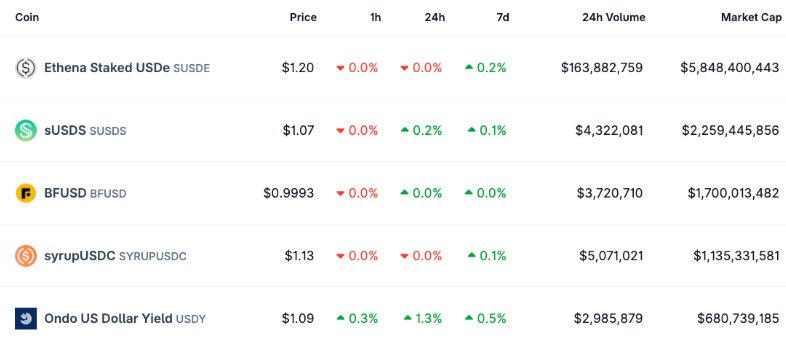
Emerging stablecoins are gaining traction by offering yield-bearing features that allow holders to earn passive income. Ethena’s USDe has been the standout, surging to a supply of $14.7 billion this year.
Carter highlighted other rising projects, including Sky’s USDS, PayPal’s PYUSD, World Liberty’s USD1, Ondo’s USDY, Paxos’ USDG, and Agora’s AUSD. Many of these tokens are designed to undercut established issuers by passing on returns from crypto-based strategies.
“Newer startups will be able to undercut the major issuers on yield and create a race to the bottom (or realistically, the top),” Carter explained, adding that Circle has already been working with Coinbase to introduce yield opportunities on USDC.
Banks enter the stablecoin race
Beyond startups, banks and financial institutions are preparing to issue their own stablecoins, a move Carter believes could reshape the industry. “No bank individually has the ability to create the necessary distribution to rival Tether, but bank consortia make by far the most sense,” he noted.
Recent developments confirm this trend. JPMorgan and Citigroup have signaled interest in stablecoin collaborations, while in Europe, ING, UniCredit, and seven other banks announced a joint venture to build a euro-backed token under the MiCA regulatory framework, set to launch by late 2026.
Disclaimer
This content is for informational purposes only and does not constitute financial, investment, or legal advice. Cryptocurrency trading involves risk and may result in financial loss.